
MEMORANDUM OF LAW
THE IMPLIED WARRANTY OF HABITABILITY: A GUIDE FOR PHILADELPHIA RESIDENTIAL TENANTS
I. WHAT IS THE WARRANTY OF HABITABILITY?
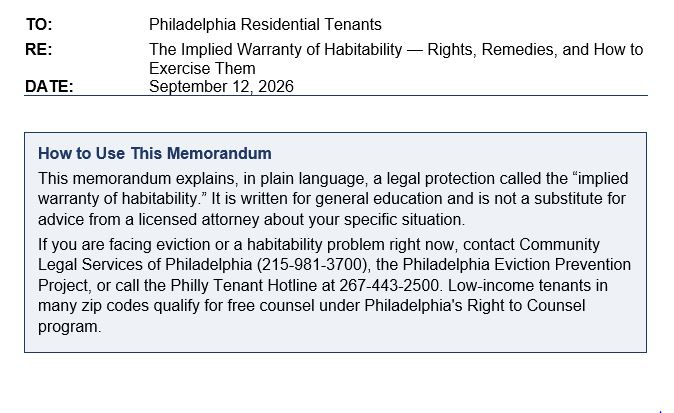
In plain terms: every residential lease in Pennsylvania — whether it is written, oral, or even just a handshake agreement — automatically includes an unwritten promise from the landlord that the rental unit is, and will remain, safe and livable. This promise exists whether or not your lease mentions it, and it exists even if your lease says you are renting the unit “as is.”
The Pennsylvania Supreme Court first recognized this rule in Pugh v. Holmes, 486 Pa. 272, 405 A.2d 897 (1979), affirming the Superior Court’s decision at Pugh v. Holmes, 253 Pa. Super. 76, 384 A.2d 1234 (1978). The Court held that a residential lease is not merely a transfer of property — it is a contract, and like any contract, each side’s promises depend on the other side’s promises. In other words, the tenant’s promise to pay rent and the landlord’s promise to provide a livable home are mutually dependent.
The Superior Court in Pugh described the warranty this way: it “is designed to insure that a landlord will provide facilities and services vital to the life, health, and safety of the tenant and to the use of the premises for residential purposes.” Pugh v. Holmes, 253 Pa. Super. at 87, 384 A.2d at 1240. This obligation applies at the start of the lease and every day afterward — the unit must have no hidden (latent) defects when you move in, and it must stay in reasonably fit condition for as long as you live there.
The Warranty Cannot Be Waived
A landlord cannot make you sign away this protection. Any lease clause that attempts to waive the warranty of habitability, or that shifts the landlord’s repair obligations onto the tenant for conditions affecting health and safety, is void and unenforceable. Fair v. Negley, 257 Pa. Super. 50, 53, 390 A.2d 240, 242 (1978). It does not matter what your lease says — the warranty is part of your tenancy by operation of law.
II. WHAT DOES “HABITABLE” ACTUALLY MEAN? (A PRACTICAL DEFINITION)
A defect breaches the warranty only if it is serious enough to “prevent the use of the dwelling for its intended purpose” — that is, it must threaten the safety, health, or basic livability of the home, not just its appearance. Pugh v. Holmes, 253 Pa. Super. at 87, 384 A.2d at 1240. Whether a particular problem is serious enough is a factual question decided case-by-case.
Covered By the Warranty (Health & Safety Defects)
• No hot and/or cold running water
• A broken sewage or plumbing system
• Inability to secure the unit (broken locks on doors or windows)
• Lack of adequate heat in winter
• Insect or rodent infestation
• A leaking roof
• Unsafe floors, stairs, porches, or handrails
• Faulty electrical wiring or lack of electricity (fire hazard)
• A broken refrigerator, where the landlord is responsible for appliances
• Any structural defect that makes the unit dangerous to occupy
• Compliance with Philadelphia Housing and Related Codes
Not Covered By the Warranty (Cosmetic Issues)
The landlord is not required to repaint faded walls, replace old carpet, or make other purely cosmetic upgrades. The warranty protects safety and livability, not appearance.
Philadelphia’s Heat Standard
Philadelphia’s Property Maintenance Code requires landlords to maintain heating equipment capable of keeping rental units at a minimum of 68°F from October through April. If you control your own thermostat, the landlord is not required to keep the unit at 68°F — that is left to your discretion — but the heating system itself must be capable of reaching that temperature.
III. WHAT RIGHTS DOES THE WARRANTY GIVE A TENANT?
When a landlord materially breaches the warranty of habitability, Pennsylvania law gives the tenant several distinct rights. You do not have to choose only one — depending on the facts, several may be available.
1. The Right to Stay and Reduce Rent (Rent Abatement)
A material breach of the warranty relieves the tenant of the obligation to pay full rent for as long as the breach continues. Pugh v. Holmes, 253 Pa. Super. 76 (1978). The tenant may remain in the unit and either sue affirmatively for damages or raise the breach as a defense or counterclaim if the landlord sues for unpaid rent. Id. The abatement is measured retroactively, for the entire period the defect existed, as the difference between the rent you agreed to pay and the fair rental value of the unit in its defective condition. Pugh v. Holmes; Kuriger v. Cramer, 345 Pa. Super. 595 (1985); Echeverria v. Holley, 2016 PA Super 119 (2016).
2. The Right to Withhold Rent
A tenant may withhold all or part of the rent until the defect is fixed, provided the tenant can prove the unit is not habitable and has given proper notice and a reasonable opportunity to repair. Withheld rent should be set aside (ideally in a separate bank account) rather than spent, so the tenant can show a judge the money was available and was not an attempt to live rent-free.
3. The Right to Repair and Deduct
In appropriate circumstances, a tenant may arrange for the repair of a defect and deduct the reasonable cost from the next rent payment(s), after giving the landlord notice and a reasonable chance to make the repair first.
4. The Right to Terminate the Lease
If the landlord is unwilling or unable to repair a serious defect within a reasonable time after notice, the tenant may terminate the lease and move out, ending any further duty to pay rent. This remedy requires actually vacating the unit and returning the keys — a tenant cannot terminate the lease while remaining in possession.
5. The Right to Sue for Damages
A tenant may file an affirmative lawsuit (in Pennsylvania practice, an action in assumpsit) to recover damages for the breach, separate from any eviction proceeding.
6. The Right to Be Free from Retaliation
A landlord may not evict, refuse to renew, or raise the rent on a tenant because the tenant exercised habitability rights or reported code violations. This protection comes from two sources:
• Pennsylvania law: the Landlord and Tenant Act of 1951 protects tenants who engage in lawful tenant organizing. 68 P.S. § 250.205.
• Philadelphia law (broader protection): the Philadelphia Fair Housing Ordinance makes it an unfair rental practice for a landlord to terminate a tenancy after the unit is found in violation of the Philadelphia Code, or to raise rent to pass along the cost of code compliance where violations went uncorrected for a year or more. Phila. Code § 9-804(1)(a), (1)(d). If a landlord tries to evict within one year of a tenant exercising these rights, the
◦ landlord — not the tenant — bears the burden of proving the eviction was not retaliatory. Phila. Code § 9-804(2)(c); see Tieger v. Philadelphia Fair Housing Comm’n, 496 A.2d 76, 79–80 (Pa. Cmwlth. 1985).
This protection is not unlimited: it does not shield a tenant who has failed to pay rent, or who has caused the code violation, nuisance, or waste. Phila. Code § 9-804(1)(a).
7. The Right to Quiet Enjoyment (a Related Protection)
Separate from, but often invoked alongside, the warranty of habitability is the implied covenant of quiet enjoyment, found in every Pennsylvania lease, which protects a tenant’s right to possess and use the unit without unreasonable interference from the landlord. Kohl v. PNC Bank Nat’l Ass’n, 863 A.2d 23, 27 (Pa. Super. 2004); Branish v. NHP Prop. Mgmt., Inc., 694 A.2d 1106, 1107 (Pa. Super. 1997). A serious enough interference may amount to a constructive eviction, which can excuse further rent payment and support a defense to an eviction action.
IV. WHAT MUST A TENANT DO TO EXERCISE THESE RIGHTS?
Pennsylvania courts require tenants to follow a specific sequence before using any remedy. Skipping a step can cost you the protection of the warranty, so follow these steps in order and keep records of everything.
1. Confirm the problem is serious enough. Ask whether the condition affects safety, health, or basic livability — not just appearance. See Section II above for examples.
2. Document the defect immediately. Take dated, clear photographs or video. Photos and code-enforcement reports are much stronger evidence than testimony alone.
3. Give the landlord written notice. Even if you first raise the issue by phone or in person, follow up in writing (text, email, or letter) and keep a copy. If your lease specifies a notice procedure, follow it exactly.
4. Allow a reasonable time to repair. What counts as “reasonable” depends on the defect and whether it is within the landlord’s control — a damaged roof might reasonably take weeks, while a lack of heat in winter should be fixed within a day or two.
5. Confirm the landlord failed to act. You must be able to show the landlord was unwilling or unable to make the repair within that reasonable time before you invoke a remedy such as withholding rent or repair-and-deduct.
6. Choose and document your remedy. If withholding rent, set the money aside (ideally in escrow or a dedicated account) rather than spending it. If repairing and deducting, keep receipts. If terminating, you must actually vacate and return the keys.
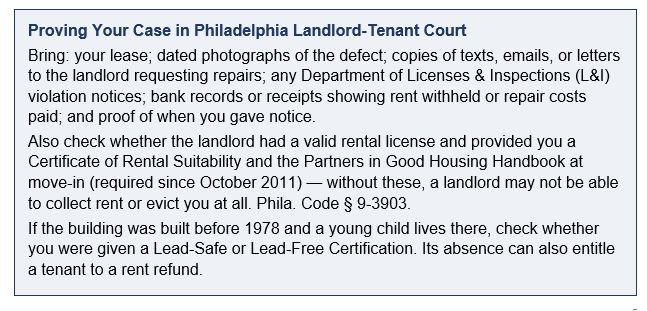
7. Keep a complete file. Save your lease, all written notices, photos, any code-enforcement (L&I) inspection reports, proof the landlord was notified, and proof of how much time passed before you acted. This is the file you would need if the landlord takes you to Landlord-Tenant Court.
8. Get legal advice before acting, if possible. Each of these remedies carries risk — a landlord who believes a remedy was used improperly may attempt an eviction for breach of the lease. Consulting an attorney or tenant organization before withholding rent or terminating a lease is strongly advised.
V. HOW MUCH RENT MAY BE WITHHELD OR RECOVERED?
There is no fixed formula. Courts and tenants commonly use a proportional approach: estimate how much of the unit’s use was lost, and for how long.
• Example: a five-room apartment loses one room to a roof leak for a full month → a tenant might withhold approximately one-fifth (20%) of that month’s rent.
• Example: a total loss of heat forces the tenant to stay elsewhere for one week of a four-week month → a tenant might withhold approximately one-fourth (25%) of that month’s rent.
The legal standard courts apply is the difference between the rent actually agreed upon and the fair rental value of the unit in its defective condition, assessed for the period the breach existed. Pugh v. Holmes, 253 Pa. Super. 76 (1978); Kuriger v. Cramer, 345 Pa. Super. 595 (1985).
VI. RISKS AND PRACTICAL WARNINGS
• A landlord may still evict a tenant for genuine non-payment of rent that was not properly withheld under the standards above.
• A remedy exercised without proper notice, without giving reasonable time to repair, or without adequate proof can be treated as a lease violation rather than a protected exercise of rights.
• Self-help eviction by a landlord (changing locks, removing belongings, shutting off utilities to force a tenant out) is not permitted in Pennsylvania residential tenancies and should be reported immediately (call 911) and can itself be used as a defense.
• An eviction case can move quickly. If you receive a Notice to Quit or a Landlord-Tenant Complaint, contact a tenant-rights organization or attorney right away rather than waiting.
VII. KEY AUTHORITIES CITED IN THIS MEMORANDUM
Case Law
• Pugh v. Holmes, 486 Pa. 272, 405 A.2d 897 (1979), aff’g 253 Pa. Super. 76, 384 A.2d 1234 (1978) — established the implied warranty of habitability in Pennsylvania residential leases.
• Fair v. Negley, 257 Pa. Super. 50, 390 A.2d 240 (1978) — the warranty of habitability cannot be waived by lease provision.
• Kuriger v. Cramer, 345 Pa. Super. 595 (1985) — tenant must prove notice, reasonable opportunity to repair, and landlord’s failure to repair to obtain a rent abatement.
• Echeverria v. Holley, 2016 PA Super 119 (2016) — reaffirming the notice-and-opportunity-to-repair requirement.
• Rivera v. Selfon Home Repairs & Improvements Co., 294 Pa. Super. 41, 439 A.2d 739 (1982) — landlord may be liable for physical injury caused by a dangerous condition violating the warranty of habitability.
• Kohl v. PNC Bank Nat’l Ass’n, 863 A.2d 23 (Pa. Super. 2004); Branish v. NHP Prop. Mgmt., Inc., 694 A.2d 1106 (Pa. Super. 1997) — the related implied covenant of quiet enjoyment.
• Tieger v. Philadelphia Fair Housing Comm’n, 496 A.2d 76 (Pa. Cmwlth. 1985) — upholding Fair Housing Commission authority over retaliatory rent increases tied to code violations.
• Wofford v. Vavreck, 22 Pa. D. & C.3d 444 (C.P. 1981) — self-help eviction for non-payment of rent is prohibited in Pennsylvania residential tenancies.
Statutes and Ordinances
• Pennsylvania Landlord and Tenant Act of 1951, 68 P.S. § 250.101 et seq. (governs Pennsylvania residential and commercial leases generally, including tenant-organizing protections at § 250.205 and security-deposit limits at § 250.511a).
• Pennsylvania “City Rent Withholding Act,” 35 P.S. § 1700-1 (suspends a tenant’s duty to pay rent directly to the landlord once a local agency certifies the dwelling unfit for human habitation).
• Philadelphia Fair Housing Ordinance, Phila. Code §§ 9-801 to 9-806 (prohibits retaliatory eviction and retaliatory rent increases tied to code violations or tenant organizing; establishes Fair Housing Commission complaint process).
• Philadelphia Property Maintenance Code, Phila. Code Title PM (minimum heat, structural safety, and other habitability standards enforced by the Department of Licenses & Inspections).
• Philadelphia Code § 9-3903 (Certificate of Rental Suitability; required tenant documents at the start of a tenancy).
This memorandum was written by Henry Langsam on September 12, 2026. If you have further questions, please contact Henry Langsam to discuss.
PA Warranty_of_Habitability_Memorandum
Disclaimer: This memorandum provides general information about Pennsylvania and Philadelphia law as of the date above and does not constitute legal advice or create an attorney-client relationship. Habitability disputes are fact-specific, and outcomes depend on the details of your lease and situation. Before withholding rent, terminating a lease, or responding to an eviction filing, consult a licensed attorney or a tenant-rights organization such as Community Legal Services of Philadelphia or the Philadelphia Eviction Prevention Project.