
MEMORANDUM OF LAW
THE IMPLIED WARRANTY: A GUIDE FOR NEW JERSEY
RESIDENTIAL TENANTS
I. WHAT IS THE WARRANTY OF HABITABILITY?
In plain terms: every residential lease in New Jersey — whether it is written, oral, or contains an express written promise to keep the unit livable — automatically includes an unwritten promise from the landlord that the rental unit is, and will remain, fit for human habitation. This promise exists whether or not your lease mentions it, and it cannot be signed away.
Unlike Pennsylvania, New Jersey’s warranty of habitability was not created by a single statute — it developed through a trilogy of New Jersey Supreme Court decisions. First, in Reste Realty Corp. v. Cooper, 53 N.J. 444, 251 A.2d 268 (1969), the Court recognized that a tenant forced out by seriously defective conditions may claim a constructive eviction. Next, in Marini v. Ireland, 56 N.J. 130, 265 A.2d 526 (1970), the Court held that every residential lease contains an implied covenant that the landlord will maintain the premises in a habitable condition throughout the tenancy, and that a tenant may repair a defect in a vital facility and deduct the reasonable cost from rent, without first obtaining a court order, once proper notice has been given.
Finally, in Berzito v. Gambino, 63 N.J. 460, 308 A.2d 17 (1973), the Court went further and held that a tenant’s covenant to pay rent and a landlord’s covenant to maintain habitable premises are mutually dependent. This means a landlord’s breach of the warranty can be raised by the tenant as a defense and set-off in a nonpayment case, or as the basis for the tenant’s own lawsuit to recover rent already paid, without requiring the tenant to vacate.
The Warranty Cannot Be Waived
A landlord cannot make a tenant sign away this protection, and it applies regardless of what the lease says. Berzito v. Gambino, 63 N.J. at 469. New Jersey’s rent-escrow statute, discussed below, reinforces this by giving tenants a court process to enforce the warranty even without a lawyer. N.J.S.A. 2A:42-85 to -98.
II. WHAT DOES “HABITABLE” ACTUALLY MEAN? (A PRACTICAL DEFINITION)
New Jersey courts distinguish between conditions that render a unit truly uninhabitable and conditions that are merely inconvenient “amenities.” Only the former breach the warranty. Berzito v. Gambino, 63 N.J. 460 (1973) (Appellate Division opinion below, 119 N.J. Super. 332, 336 (App. Div. 1972)). The condition complained of “must be such as truly to render the premises uninhabitable in the eyes of a reasonable person.” Marini v. Ireland, 56 N.J. 130 (1970).
Covered By the Warranty (Uninhabitable Conditions)
• Lack of heat, hot water, or running water
• Loss of electricity or gas service
• No working elevator, where one is needed for reasonable access (especially for upper-floor units)
• No garbage removal service in a multi-family building
• Broken or inadequate locks on doors and windows
• Insect or rodent infestation, including bed bugs
• Sewage backups or inadequate sewage disposal
• Structural defects, unsafe stairs, or fire hazards
• Serious leaks, mold, or hazardous lead paint conditions
• Compliance with Applicable Housing and Related Codes
Not Covered By the Warranty (“Amenities”)
New Jersey courts have specifically held that malfunctioning venetian blinds, minor water leaks, wall cracks, and lack of interior painting are “amenities,” not habitability defects, and will not support a rent abatement. Berzito v. Gambino, 119 N.J. Super. at 336 (App. Div. 1972). The warranty protects safety and basic livability, not cosmetic condition.
New Jersey’s Heat Standard
Under New Jersey Department of Community Affairs regulations implementing the Hotel and Multiple Dwelling Law, N.J.S.A. 55:13A-1 et seq., landlords of covered multi-family buildings must supply heat from October 1 through May 1 so that units reach at least 68°F from 6:00 a.m. to 11:00 p.m. and at least 65°F from 11:00 p.m. to 6:00 a.m. This obligation does not apply where heat is generated by equipment within the tenant’s exclusive control and supplied directly by a public utility.
III. WHAT RIGHTS DOES THE WARRANTY GIVE A TENANT?
When a landlord breaches the warranty of habitability, New Jersey law gives the tenant several distinct rights and remedies. A tenant is not limited to only one — depending on the facts, more than one may be available.
1. The Right to Stay and Withhold or Set Off Rent
A tenant may remain in possession and, in a nonpayment action brought by the landlord, raise the landlord’s breach of the warranty as a defense and set-off against the rent claimed. Berzito v. Gambino, 63 N.J. 460 (1973); Marini v. Ireland, 56 N.J. 130, 140 (1970). The set-off is measured as the difference between the rent reserved in the lease and the fair rental value of the premises in their defective condition. Berzito, 63 N.J. at 469; Academy Spires, Inc. v. Brown, 111 N.J. Super. 477, 268 A.2d 556 (Cty. D. Ct. 1970) (identifying factors relevant to calculating the percentage abatement).
2. The Right to Sue Affirmatively for Rent Already Paid
A tenant does not have to wait for a nonpayment suit. A tenant may independently sue the landlord to recover part or all of a security deposit, or part or all of rent already paid, on the theory that the landlord breached the covenant of habitability. Berzito v. Gambino, 63 N.J. 460 (1973).
3. The Right to Repair and Deduct
A tenant may repair a defect in a vital facility and deduct the reasonable cost from rent, without first obtaining court approval, so long as the tenant first gave the landlord clear notice of the defect, requested that it be corrected, and allowed a reasonable time for the landlord to act. Marini v. Ireland, 56 N.J. 130, 144–46 (1970).
4. The Right to Vacate on a Constructive Eviction Theory
If the condition is severe enough to make the unit unusable for its intended purpose, a tenant may treat the lease as terminated on a theory of constructive eviction, ending the obligation to pay further rent. Reste Realty Corp. v. Cooper, 53 N.J. 444 (1969). This remedy requires the tenant to actually vacate within a reasonable time after the right to claim constructive eviction arises — waiting too long while remaining in the unit can forfeit the claim. Reste Realty; Berzito v. Gambino, 119 N.J. Super. at 336 (App. Div. 1972).
5. The Statutory Right to Rent Escrow (“Rent Receiver” Actions)
New Jersey’s rent-escrow statute, enacted after Berzito, allows a tenant in a substandard dwelling to deposit rent with a court-appointed administrator, rather than paying the landlord directly, until the conditions are corrected. N.J.S.A. 2A:42-85 to -98. A tenant or municipal housing inspector may file this action in the Special Civil Part in the county where the property is located; unlike some other remedies, no prior deposit of rent is required to start the case. If the fair rental value of the defective unit is less than the amount deposited, the tenant is entitled to a rent abatement reflecting that difference. Where a landlord has a persistent history of refusing to correct conditions depriving tenants of heat, water, or electricity, a court may go further and appoint a rent receiver to collect rents for the building and use them to make repairs. N.J.S.A. 2A:42-85, 2A:42-114.
6. The Right to Be Free from Retaliation
New Jersey law broadly bars a landlord from serving a notice to quit or filing an eviction case in retaliation for a tenant’s protected conduct. N.J.S.A. 2A:42-10.10 to -10.14. Protected conduct includes a tenant’s:
• Good-faith complaint to a governmental authority about a health or safety violation
• Participation in, or organizing of, a tenant organization
• Good-faith request that the landlord make repairs or correct habitability problems
• Filing of a lawsuit against the landlord
• Withholding of rent based on the landlord’s failure to maintain habitable conditions
A retaliatory notice to quit or eviction complaint served within statutory protected periods is a defense to the eviction action itself. N.J.S.A. 2A:42-10.10 to -10.12.
7. The Right Not to Be Evicted Without “Good Cause”
New Jersey is unusual: most residential tenants cannot be evicted at all unless the landlord proves one of the specific statutory grounds listed in the Anti-Eviction Act, N.J.S.A. 2A:18-61.1 et seq. — for example, nonpayment of rent, a substantial lease violation after notice to cure, disorderly conduct, or the owner’s permanent retirement of the building from residential use. A landlord cannot simply decline to renew a lease or evict because the term expired; some recognized statutory ground is required, and the required pre-suit notice (commonly a Notice to Quit, with time periods set out at N.J.S.A. 2A:18-61.2) must be strictly followed before an eviction complaint may be filed.
IV. WHAT MUST A TENANT DO TO EXERCISE THESE RIGHTS?
New Jersey courts require tenants to follow a specific sequence before using any remedy. Skipping a step can cost you the protection of the warranty, so follow these steps in order and keep records of everything.
1. Confirm the problem is serious enough. Ask whether the condition makes the unit truly uninhabitable to a reasonable person — not merely an inconvenience or cosmetic issue. See Section II above.
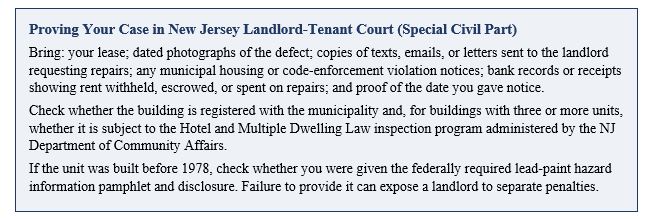
2. Document the defect immediately. Take dated, clear photographs or video. Photos and municipal housing-inspection reports are much stronger evidence than testimony alone.
3. Give the landlord clear, positive notice. New Jersey law requires “positive and seasonable notice of the alleged defect” and a request that it be corrected. Put this in writing (text, email, or letter) even if you first raised it verbally, and keep a copy. Marini v. Ireland, 56 N.J. 130 (1970).
4. Allow a reasonable time to repair. What counts as “reasonable” depends on the nature of the defect and whether correcting it is within the landlord’s control — loss of heat in winter should be addressed within a day or two, while a more complex repair may reasonably take longer.
5. Confirm the landlord failed to act. You must be able to show the landlord did not make the repair within a reasonable time after notice before invoking a remedy such as repair-and-deduct, rent escrow, or withholding.
6. Choose and document your remedy. If repairing and deducting, keep receipts and only deduct the reasonable cost of the specific vital-facility repair. If pursuing rent escrow, file with the Special Civil Part in the county where the property sits. If claiming constructive eviction, you must actually vacate within a reasonable time.
7. Keep a complete file. Save your lease, all written notices, photos, any DCA or municipal inspection reports, proof the landlord was notified, and proof of how much time passed before you acted. This is the file you would need in Special Civil Part.
8. Get legal advice before acting, if possible. Each of these remedies carries risk — a landlord who believes a remedy was used improperly, or who has an independent good-cause ground, may still file an eviction complaint. Consulting Legal Services of New Jersey or a private attorney before withholding rent or claiming constructive eviction is strongly advised.
V. HOW MUCH RENT MAY BE WITHHELD OR RECOVERED?
There is no fixed formula. New Jersey courts calculate the abatement as the difference between the rent reserved in the lease and the fair rental value of the unit in its defective condition, for the period the defect existed. Berzito v. Gambino, 63 N.J. 460, 469 (1973).
The trial court in Academy Spires, Inc. v. Brown, 111 N.J. Super. 477 (Cty. D. Ct. 1970), identified factors relevant to setting that percentage, including: the severity of the defect and how it affects the tenant’s use of the unit, whether the defect affects the entire unit or only part of it, the duration of the problem, and whether the landlord’s efforts to repair were reasonable under the circumstances.
• Example: a heating outage during a cold winter month, forcing a tenant to stay elsewhere for a week, could support a meaningful abatement for that period, since heat is a core habitability item, not an “amenity.”
• Example: a single malfunctioning window blind or unpainted wall, standing alone, is unlikely to support any abatement, because New Jersey courts have classified such items as amenities rather than uninhabitability.
VI. RISKS AND PRACTICAL WARNINGS
• A landlord may still obtain a judgment for possession where the Anti-Eviction Act’s good-cause requirements are independently satisfied (for example, genuine, unexcused nonpayment of rent that was not properly withheld or escrowed).
• A remedy exercised without proper notice, without giving reasonable time to repair, or against a merely cosmetic “amenity” defect can be treated as an unjustified rent shortfall rather than a protected exercise of rights.
• Claiming constructive eviction requires actually vacating within a reasonable time; continuing to live in the unit while claiming the lease is terminated can defeat the claim.
• An eviction complaint in New Jersey’s Special Civil Part can move quickly and requires strict compliance with notice periods under N.J.S.A. 2A:18-61.2. If you receive a Notice to Quit or a Special Civil Part complaint, contact Legal Services of New Jersey or an attorney right away.
VII. KEY AUTHORITIES CITED IN THIS MEMORANDUM
Case Law
• Reste Realty Corp. v. Cooper, 53 N.J. 444, 251 A.2d 268 (1969) — recognized constructive eviction as a tenant remedy and foreshadowed the implied warranty of habitability.
• Marini v. Ireland, 56 N.J. 130, 265 A.2d 526 (1970) — established the implied warranty of habitability in New Jersey residential leases and the repair-and-deduct remedy, subject to notice and a reasonable opportunity to repair.
• Berzito v. Gambino, 63 N.J. 460, 308 A.2d 17 (1973), aff’g in relevant part 119 N.J. Super. 332 (App. Div. 1972) — held the tenant’s duty to pay rent and the landlord’s duty to maintain habitable premises are mutually dependent; established the rent abatement/set-off remedy and distinguished uninhabitability from mere “amenities.”
• Academy Spires, Inc. v. Brown, 111 N.J. Super. 477, 268 A.2d 556 (Cty. D. Ct. 1970) — identifying factors for calculating the percentage of rent abatement.
Statutes and Regulations
• New Jersey Anti-Eviction Act, N.J.S.A. 2A:18-61.1 to -61.16a (limits eviction of covered residential tenants to specific statutory “good cause” grounds; notice periods at N.J.S.A. 2A:18-61.2).
• Rent Escrow / Substandard Dwelling statute, N.J.S.A. 2A:42-85 to -98 (P.L. 1971, c. 224) (allows tenants to deposit rent with a court-appointed administrator pending repair of substandard conditions, and provides for appointment of a rent receiver under related provisions at N.J.S.A. 2A:42-114).
• Anti-Reprisal (Retaliatory Eviction) statute, N.J.S.A. 2A:42-10.10 to -10.14 (prohibits a landlord from serving a notice to quit or filing an eviction action in retaliation for protected tenant conduct, including code complaints, repair requests, tenant organizing, and rent withholding based on habitability).
• Hotel and Multiple Dwelling Law, N.J.S.A. 55:13A-1 et seq., and its implementing regulations (New Jersey Department of Community Affairs) (statewide habitability, maintenance, and heat standards — minimum 68°F daytime / 65°F nighttime heat from October 1 through May 1 — for covered multi-family buildings).
• Truth-in-Renting Act, N.J.S.A. 46:8-45 to -49 (requires landlords to provide tenants a state-published statement of legal rights and responsibilities).
• Security Deposit Law, N.J.S.A. 46:8-19 to -26 (caps security deposits and governs their return).
This memorandum was written by Henry Langsam on September 12, 2026. If you have further questions, please contact Henry Langsam to discuss.
Disclaimer: This memorandum provides general information about New Jersey law as of the date above and does not constitute legal advice or create an attorney-client relationship. Habitability disputes are fact-specific, and outcomes depend on the details of your lease, your municipality’s housing code, and your situation. Before withholding rent, filing a rent-escrow action, or claiming constructive eviction, consult a licensed attorney or Legal Services of New Jersey.