
What Pennsylvania’s Unfair Trade Practices and Consumer Protection Law Means for You
If you’ve ever felt misled by an advertisement, pressured into a bad deal, or stuck with a product that didn’t perform as promised, Pennsylvania law may already be on your side. Since 1968, the state’s Unfair Trade Practices and Consumer Protection Law (UTPCPL) has given consumers a powerful tool for pushing back against dishonest or deceptive business practices. Despite having been on the books for decades, many people — and even many businesses — don’t fully realize how broad its protections are or how much leverage it can provide.
What the Law Is Designed to Do
At its core, the UTPCPL exists to keep the marketplace honest. It prohibits businesses from using unfair or deceptive tactics to sell goods and services, and it gives ordinary consumers a way to fight back when they’ve been harmed by that kind of conduct.
Enforcement works on two tracks. The Consumer Protection Bureau within the Pennsylvania Attorney General’s Office investigates complaints and can bring its own enforcement actions. But in practice, most cases under this law are filed by consumers themselves through private lawsuits. That means you don’t need to wait for the government to act — if you’ve been the victim of an unfair trade practice, you may be able to pursue your own claim.
The Kinds of Conduct the Law Targets
The statute lays out a detailed list of specific business practices considered unfair or deceptive. Some of the most common examples include:
● Misleading advertising about a product’s origin or source — falsely suggesting who made a product, where it came from, or that it’s affiliated with, sponsored by, or approved by another company or organization.
● False claims about a product’s qualities — for example, advertising that goods have ingredients, features, or a level of quality they don’t actually have, or selling used or reconditioned items as new.
● “Bait and switch” advertising — advertising a product or service with no real intention of selling it as advertised, or without enough inventory to meet reasonably expected demand, unless the ad clearly discloses a quantity limit.
● Unnecessary repair or replacement claims — telling a customer that repairs or replacement parts are needed when they aren’t. This shows up frequently in disputes with auto dealers and repair shops, including inflated rust-proofing claims.
● Failure to honor written warranties.
● Pyramid schemes, chain letters, and contingent referral payments — the law specifically targets sales schemes where a buyer is promised compensation for recruiting other buyers, along with the classic chain letter and any deal where a “referral fee” depends on a future event happening.
● Telemarketing violations — telemarketers are required to clearly state up front who is calling, that the call is a sales call, what’s being sold, and — if a prize is involved — that no purchase is necessary to win. Anyone who has fielded a sales call that skipped all of that has likely experienced a violation firsthand.
The “Catchall” Provision — The Law’s Broadest Tool
Beyond its list of specific prohibited practices, the UTPCPL includes a final, broadly worded provision often called the “catchall.” It prohibits any other deceptive conduct that creates a likelihood of confusion or misunderstanding among consumers.
Because it isn’t tied to a specific, narrowly defined practice, this provision is the one most frequently invoked in lawsuits — and also the most legally contested. Pennsylvania courts have gone back and forth on exactly what a consumer must prove to win a catchall claim, and the state’s highest court has not yet issued a definitive answer. In practical terms, this means the catchall provision can potentially reach conduct that doesn’t fit neatly into any of the law’s other categories, which is part of what makes the statute so useful — and, from a business’s perspective, so unpredictable.
The catchall provision is also attractive to consumers for a more practical reason: claims under the UTPCPL benefit from a six-year statute of limitations, compared to the much shorter two-year window for ordinary fraud claims. That extra time can matter a great deal for someone who didn’t discover a problem right away.
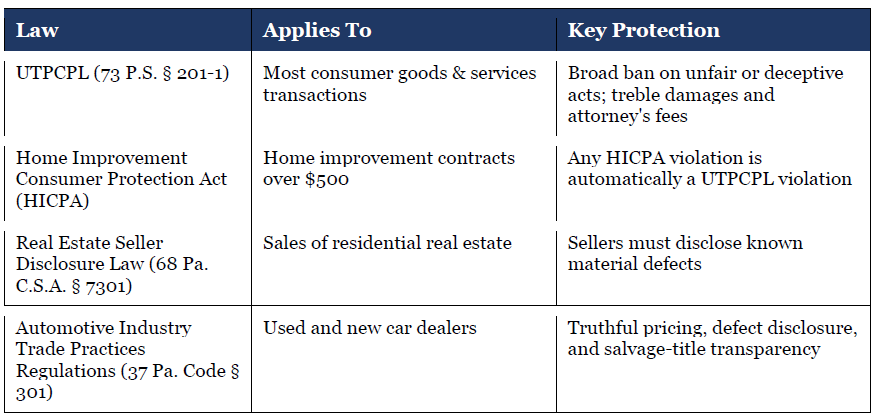
Pennsylvania Consumer Protection Laws at a Glance
The UTPCPL rarely works alone. Several related Pennsylvania statutes feed directly into it, extending its reach into specific industries:
Special Protections for Used Car Buyers
Buying a used car is one of the most common places consumers run into unfair trade practices, and Pennsylvania has built out a whole set of specific protections in this area. In addition to the UTPCPL itself, dealers are governed by the state’s Automotive Industry Trade Practices regulations (37 Pa. Code § 301), which spell out in detail what a dealer can and cannot do when advertising and selling a vehicle. Together, these rules give used car buyers several concrete protections:
● Truthful advertising and pricing. The price a dealer advertises must include any charges that arise before the car is delivered to you. Once you’ve agreed to a price, the dealer cannot tack on additional charges for freight, handling, or “dealer preparation.” Document fees are also capped by law, so a dealer cannot pad your bill with excessive paperwork charges.
● Honest trade-in offers. If a dealer advertises a trade-in allowance, they must disclose upfront whether that offer will be reduced based on the condition of the vehicle you’re trading in.
● Disclosure of known defects. Dealers are required to disclose known problems such as prior water damage, frame damage, or significant issues with the engine, transmission, or differential — the kinds of hidden problems that are expensive to discover after the sale.
● Salvage title transparency. If a vehicle has a salvage or rebuilt title, that history must be disclosed to the buyer and reflected on the title itself, so a car’s damage history follows it and can’t be quietly erased through a resale.
● Accountability for “like new” claims. If a dealer represents a vehicle as being in excellent condition when it has actually been in a significant accident or structurally repaired, that misrepresentation can support a UTPCPL claim.
These protections matter because a used car is often one of the largest purchases a family makes outside of a home, and the consequences of hidden defects or padded charges can be serious. When a dealer cuts corners on these obligations, a buyer who can show the dealer’s conduct was unfair or deceptive may be able to have the sales contract invalidated, recover a refund, or pursue damages — including the UTPCPL’s treble damages and attorney’s fees — rather than being stuck with a lemon and no recourse.
When a Privacy Breach Becomes a UTPCPL Claim: The HIPAA Connection
Consumers are often surprised to learn that a violation of federal medical privacy law — HIPAA (the Health Insurance Portability and Accountability Act) — can also become the basis of a UTPCPL claim, even though HIPAA itself does not allow individuals to sue directly. HIPAA is enforced by the federal government, not by private lawsuits, so on its own, a HIPAA violation doesn’t give a patient a direct right to sue the healthcare provider or insurer responsible.
That’s where the UTPCPL comes in. Pennsylvania courts have recognized that when a healthcare provider, pharmacy, insurer, or other business tells its patients or customers that their health information will be kept confidential and handled in compliance with the law — and then that promise turns out to be false because the business improperly disclosed, sold, or failed to secure that information — the broken promise itself can amount to an unfair or deceptive practice under the UTPCPL. In other words, it isn’t the HIPAA violation alone that creates liability; it’s the fact that the business made a representation about protecting your privacy that it didn’t honor. That kind of misrepresentation fits squarely within the UTPCPL’s protections against deceptive conduct, including its catchall provision.
This distinction matters in practice. Courts have been willing to let UTPCPL claims move forward in cases involving data breaches and unauthorized disclosures of medical records, even while rejecting attempts to base a claim purely on the HIPAA violation itself (for example, in ordinary negligence cases). The lesson for consumers is that a healthcare-related privacy breach isn’t necessarily a dead end just because HIPAA itself won’t let you sue — if the business’s own promises about protecting your information were false or misleading, the UTPCPL may still provide a path to relief, including the possibility of treble damages and attorney’s fees.
The Home Improvement Consumer Protection Act: A Built-In UTPCPL Violation
Home renovations and repairs are another area where Pennsylvania consumers have run into serious trouble, prompting the legislature to pass a dedicated law in 2009: the Home Improvement Consumer Protection Act (HICPA). HICPA applies to contracts for home improvement work over $500 on private residences — things like remodeling, roofing, additions, decks, driveways, and similar projects. It doesn’t cover commercial properties, apartment buildings, or brand-new home construction.
HICPA requires contractors doing a meaningful amount of business with consumers to register with the Attorney General’s Bureau of Consumer Protection, and it sets out specific requirements that must appear in a written home improvement contract — along with certain terms that a contractor is not allowed to include, such as provisions that would unfairly limit a homeowner’s right to recover damages. HICPA also restricts what a contractor can do during the course of the job, prohibiting things such as:
● Demanding payment before a contract is signed, or collecting more than one-third of the contract price as a deposit on jobs over $1,000.
● Advertising a project at a price the contractor never intends to honor.
● Providing false or misleading information to get a homeowner to sign a contract.
● Accepting payment and then failing to deliver the promised materials or services.
● Altering a signed contract without the homeowner’s consent, or changing key business information without notifying the homeowner in writing.
What makes HICPA especially significant is a single, powerful sentence built into the statute: a violation of any provision of HICPA is automatically deemed a violation of the UTPCPL. Homeowners don’t need to separately prove that a contractor’s conduct fits within one of the UTPCPL’s other categories — establishing a HICPA violation is enough on its own to trigger the full range of UTPCPL remedies, including treble damages and attorney’s fees. Pennsylvania courts have applied this rule even for what might look like technical or paperwork violations, because the legislature designed HICPA specifically to close the gaps that unscrupulous contractors had been exploiting.
In practice, this means a homeowner who hired a contractor that took a large deposit up front, walked away from a job, or buried unfavorable terms in a non-compliant contract may have a much stronger claim than they’d expect — not just for breach of contract, but for treble damages and attorney’s fees under the UTPCPL by way of HICPA.
Real Estate and Other Expanding Applications
Although the law was written with “goods and services” in mind, Pennsylvania courts have extended its reach over the years. Notably, the sale of residential real estate has been held to fall within the law’s protections, meaning claims against real estate sellers and agents for misrepresentations are now common alongside traditional consumer disputes.
What You Can Recover: Damages and Attorney Fees
One of the biggest reasons the UTPCPL carries so much weight is its remedies provision. A consumer who purchased goods or services for personal, family, or household use — and suffered a financial loss because of an unfair trade practice — can sue to recover their actual damages, or $100, whichever is greater.
More significantly, a court has the discretion to award up to three times the actual damages proven, plus reasonable attorney’s fees. While courts don’t award full treble damages in every case, the mere possibility of tripled damages and a fee award creates strong pressure to resolve claims fairly and quickly, rather than risk a larger judgment at trial.
A Real-World Example: Undisclosed Defects in a Home Sale
To illustrate how these protections play out in practice, consider a case our firm handled involving the sale of a condominium unit. The buyer purchased the unit after the seller provided a written property disclosure statement — required under Pennsylvania’s Real Estate Seller Disclosure Law — representing that there were no known issues with the roof, no history of leaks, no past or present water infiltration, and no structural or electrical problems.
Almost immediately after settlement, the buyer discovered a very different reality: significant leaks, water infiltration, cracking and buckling in the ceilings and walls, and electrical problems serious enough to create a fire hazard. It turned out that during the pre-purchase home inspection, the inspector had actually flagged a stained area on the ceiling — and the seller’s agent responded at the time by explaining that the stain was from an old moisture issue that had been fully resolved. That representation was never corrected, even though there was reason to believe similar units in the same building had an ongoing history of roof-related leaks.
Because the seller and the seller’s agents had made specific representations denying any defects — and, according to the buyer, knew or should have known those representations were false — the resulting lawsuit included not only claims for fraudulent and negligent misrepresentation and violation of the Real Estate Seller Disclosure Law, but also a claim under the UTPCPL. The UTPCPL count argued that the seller and the agents had represented the property as having characteristics and a standard of quality it did not actually have, and that their conduct, taken together, amounted to fraudulent or deceptive conduct creating a likelihood of confusion or misunderstanding — the catchall provision discussed above.
This kind of case shows why the UTPCPL is so often paired with a real estate misrepresentation claim: a seller’s inaccurate disclosure statement or a misleading verbal reassurance about a defect isn’t just a broken promise — it can be an unfair or deceptive act that opens the door to treble damages, punitive damages, and an award of attorney’s fees and costs. In our experience, that combination is often what turns a difficult, expensive dispute into a case that can be resolved favorably for the homeowner.
Why This Matters to You
Whether you’ve been misled by a seller, pressured into a questionable sales scheme, sold a used item represented as new, or subjected to warranty or repair issues you shouldn’t have to pay for, the UTPCPL may give you a path to recover your losses — and then some. Because the law’s boundaries, particularly around the catchall provision, are still being shaped by the courts, it’s worth having an experienced attorney evaluate whether your situation qualifies.
If you believe you’ve been the victim of an unfair or deceptive business practice in Pennsylvania, we encourage you to reach out to our office to discuss your options.
This article was prepared by Henry Langsam on September 14, 2026