
We are introducing the Environmental Forensic Notes series to present background information about different classes of chemicals to environmental managers who face questions such as:
- Whose contamination is it?
- When did the contamination occur?
- Am I liable, and if yes, what is my share?
Environmental Forensic Notes will provide information to shed light on the steps needed to satisfy a successful environmental forensic investigation and to answer the questions above, presenting comprehensive information about the different classes of chemicals.
We start this series with polychlorinated biphenyls (PCBs), the “miracle chemical” that was used from the 1930s through the 1970s, followed by a downfall in use that coincided with the rise of environmental investigations and liability for site cleanups.
PCB Aroclors
In the 1930s, PCBs were introduced to the market as fireproof fluids in electrical equipment and heat transfer units, among other industrial applications (e.g., dielectric fluids for capacitors and transformers; hydraulic fluids; and plasticizers in rubber, paint, caulking, and carbonless copy paper). In the 1970s, concerns about PCB contamination in the environment coupled with the evolution of environmental regulations resulted in the federal government phasing out PCB use in commercial applications. Today, and despite decades of restricted use, PCBs persist in the environment, requiring investigations and cleanups.
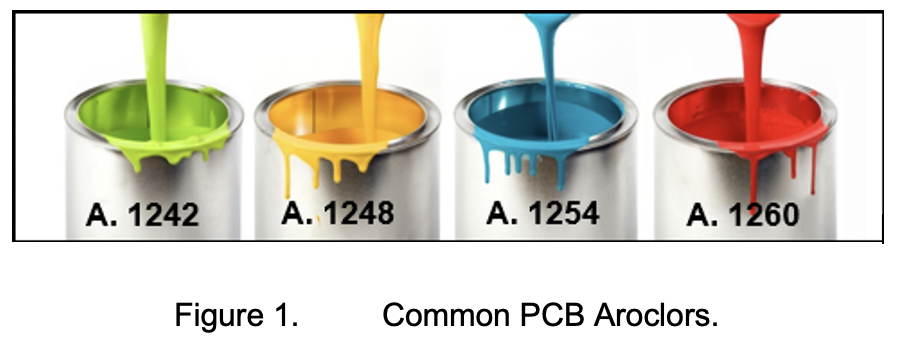
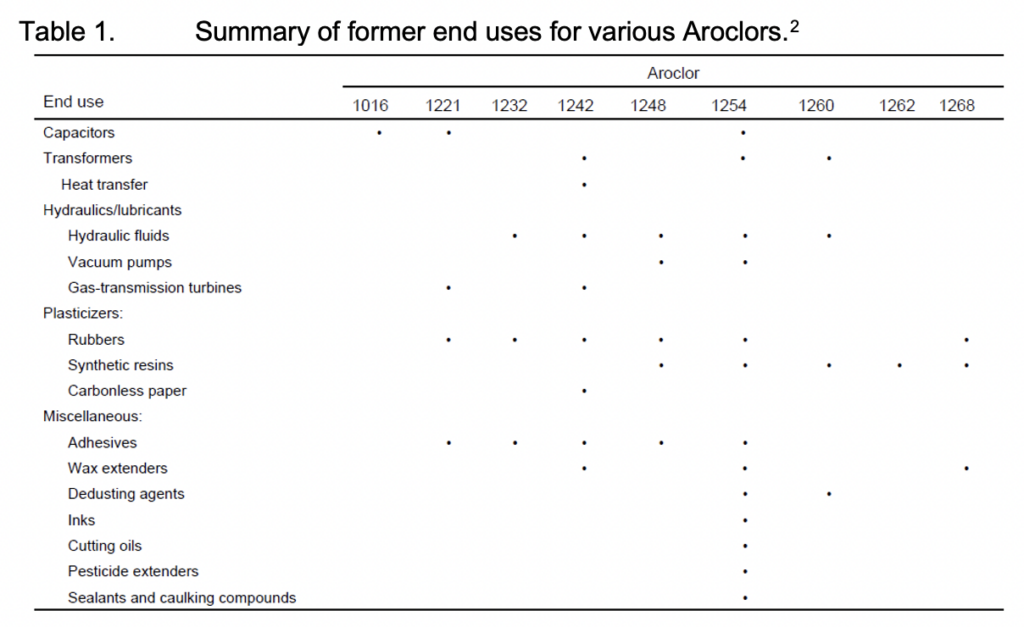
Monsanto Chemical Corporation commercially marketed PCBs in the United States under the Aroclor® trademark.[1] Aroclor 1242, Aroclor 1248, Aroclor 1254, and Aroclor 1260 are the most common types of Aroclors encountered in environmental investigations. To help visualize what Aroclors are, think of them as cans of paint with each Aroclor having a different color and a set of specific uses (see Figure 1 and Table 1 for uses).
Laboratories use Method 8082 to analyze for PCBs in an environmental sample. Method 8082 is a relatively inexpensive process to identify the type of Aroclor or mixtures of Aroclors in a sample. The output of Method 8082 is a concentration of each individual Aroclor. The summation of all Aroclor concentrations gives the total PCB concentration in the sample, which is compared to regulatory threshold values to determine whether cleanup is needed. A PCB congener analysis may be needed to design a full fingerprinting investigation, as discussed below.
PCB Congeners
Each PCB Aroclor is composed of a mixture of many compounds called congeners. Continuing with our hypothetical example, a can of red paint could have many ingredients that when added together in certain percentages, form the desired color (i.e., the desired Aroclor). PCBs consist of 209 discrete congeners, a group of compounds with the same chemical backbone (a biphenyl ring). The difference between one congener and another is the number of chlorine atoms attached to the biphenyl ring.
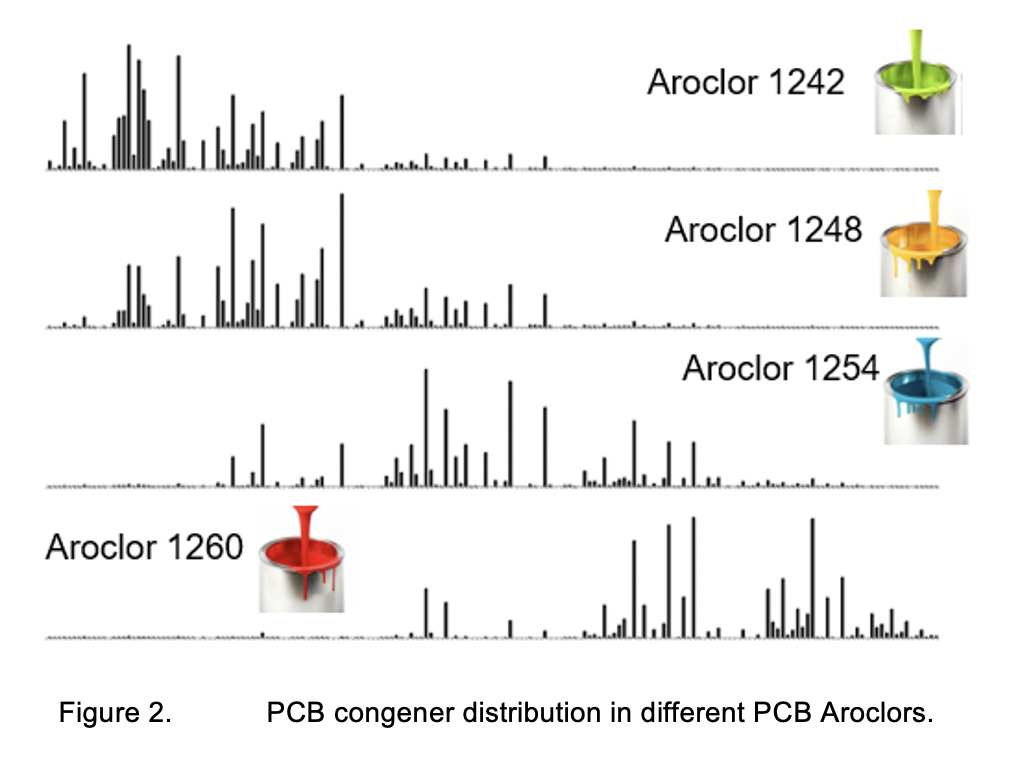
Laboratories use Method 1668 to analyze for the exact PCB congener composition in an environmental sample.[3] Figure 2 shows the PCB congener compositions of some of the common Aroclors.[4] The figure shows black bars with different heights plotted along a horizontal axis. Each black bar represents a PCB congener and the height of the bar represents the concentration of that congener relative to the other congeners. The first congener on the horizontal axis is referred to as PCB-1 (plotted on the left-hand end of the horizontal axis); the last congener (plotted on the right-hand end of the horizontal axis is PCB-209. PCB-1 contains 1 chlorine atom, while PCB-209 contains 10 chlorine atoms. As the number of chlorine atoms increases, the PCB congener becomes relatively heavier. One can see that the congeners that make up Aroclor 1242 are plotted mostly on the left-hand side, while Aroclor 1260 has more congeners plotted on the right-hand side. Therefore, Aroclor 1260 is heavier than Aroclor 1242.
PCBs and TSCA
In 1966, the public was alerted to PCBs as a potential environmental or human health issue when the publication New Scientist reported the observations by the Swedish scientist, Sören Jensen, of PCB presence in fish and bird tissue.[5] Some examples of the evolution of the scientific understanding of PCBs, their regulatory control, and industrial implications in the 1970s are the following:
- In 1971, a Federal Interagency Task Force met to address toxicological, regulatory, and environmental concerns of PCBs. In the same year, Monsanto, the only producer of PCBs in the United States, voluntarily phased out PCB production for “open systems”[6] and restricted the sale of PCBs for use as an electric fluid in sealed electrical equipment.
- In 1974, the American National Standards Institute published PCB handling and disposal guidelines for shipping, in-plant handling, and disposal (ANSI, 1974).
- In 1976, the Toxic Substances Control Act (TSCA) passed by Congress gave U.S. EPA broad authority to regulate virtually all aspects of the manufacture, distribution, use, and disposal of chemicals in the United States. TSCA was the first law passed by Congress that specifically addressed a single chemical group (i.e., PCBs). TSCA Section 6(e) banned the manufacture, processing, distribution in commerce, or use of PCBs after January 1, 1978, unless such activities were carried out in “totally enclosed systems” (Erickson, 1997). Congress gave U.S. EPA the authority to determine which activities were totally enclosed.
- In August 1977, Monsanto ceased all PCB production and many manufacturers voluntarily stopped using PCBs even before this date.
- In May 1979, U.S. EPA promulgated regulations that defined certain PCB-containing electrical equipment as “totally enclosed,”[7] and hence, electrical equipment was regulated differently.
The TSCA regulations mandated that a transformer retrofill program replace PCB fluids with other non-PCB coolants. Prior to the TSCA regulations, maintaining records on handling PCB transformer fluids was not required. TSCA required cleanup and recordkeeping of all spills that occurred on or after July 1, 1979.
Many other important events regarding PCBs have occurred, but it can be seen from the list above that in the decade of the 1970s, PCB environmental issues were clarified from a regulatory perspective. Regulations controlling the use and disposal of PCBs continued to evolve in the 1980s and beyond.[8]
What is PCB Fingerprinting and How Can it be Used to Allocate Contamination Liability?
PCB fingerprinting is a set of well-established techniques used to distinguish the sources of contamination in environmental media. Techniques vary from simple profile comparisons to more complex methods.
PCB profile comparisons (i.e., comparisons of the congener distribution in an environmental sample) are used in situations when a Potentially Responsible Party (PRP) used markedly different PCB Aroclors in their operations. For example, if PRP1 used Aroclor 1242 and PRP2 used Aroclor 1260 and an environmental sample (e.g., soil sample) contains Arolcor 1242, then one can deduce that PRP1 is liable for the PCBs in that environmental sample.
In situations where PCB profiles in contaminated areas are a mix of different sources, mathematical models can be used to numerically “unmix” the PCB profiles and allocate percent contributions from different sources.
In more complex situations, multiple PRPs may have used the same Aroclor or some PRPs may have used different Aroclors at different times. In those situations, multiple lines of evidence are needed to allocate contamination to different PRPs. For example, it may be possible to identify marker compounds associated with an Aroclor batch used by one PRP but not the others (e.g., polychlorinated terphenyls—a group of compounds with characteristics similar to PCBs), or isotope methods may be used for sediment age-dating to identify the approximate period of contaminant release.
Beyond the discussion above, a forensic investigation may need to include an understanding of history of operations at a site and the evolution in laboratory analysis tools and environmental regulations, weathering of PCBs congeners, and other fingerprinting techniques such as age dating of contamination in environmental media to reconstruct a history of operations and releases and track liability for the contamination.
This article was written by Tarek Saba, Ph.D., the Principal Scientist & Office Director at Exponent, Inc. Tarek can be reached at tsaba@exponent.com or 617.510.8202.
[1] The generic name for dielectric fluids containing PCBs was “Askarel,” which was typically a mixture of Aroclors and chlorinated benzenes. Other companies marketed Askarels under the trade names “Pyranol” and “Inerteen.”
[2] Toxicological profile for polychlorinated biphenyls (PCBs). 2000. U.S. Department of Health and Human Services. Public Health Services, Agency for Toxic Substances and Disease Registry. November.
[3] Until the early 1970s, PCBs could not be measured reliably in environmental samples. In fact, the regulatory community did not adopt any standard method for PCB analysis in solid wastes until 1980 when the U.S. EPA issued the “SW-846” manual of analytical methods for solid wastes. Presently, the U.S. EPA methods for PCB measurements include Method 8082 (analysis of Aroclors®) and the high-resolution Method 1668A (congener analysis).
[4] The last two digits represent the approximate degree of chlorination of the product, that is, Aroclor 1242 had roughly 42 percent chlorine by weight and Aroclor 1260 had about 60 percent chlorine by weight.
[5] “Report of a New Chemical Hazard,” December 15, 1966; New Scientist, London, United Kingdom
[6] Open systems include adhesives, sealants, chlorinated rubber products, specialty paints, etc.
[7] Enclosed systems include rail car transformers, industrial heat exchangers, and hydraulic power equipment.
[8] A list of PCB laws and regulations, and Federal Register Notices are published on the U.S. EPA website: http://www.epa.gov/opptintr/pcb/laws.html.